Responsible expertise and sustainable development
Sustainable development is one of the shared competencies of applied university degrees. Jamk, like other universities of applied sciences, is committed to training experts who can promote sustainable development in working life and society. Sustainability and responsibility run through all education and drive the societal shift towards sustainability. (Jamk strategy; Jamk’s Quality Manual, Arene Sustainability programme of UAS)
Tips for creating a curriculum that promotes sustainable development
- Get familiar with the sustainable development learning outcomes of the degree programme.
- Identify how your course enhances the student’s expertise related to the UN’s sustainable development goals and targets.
- Plan the assessment. Include sustainable development in the course’s assessment criteria.
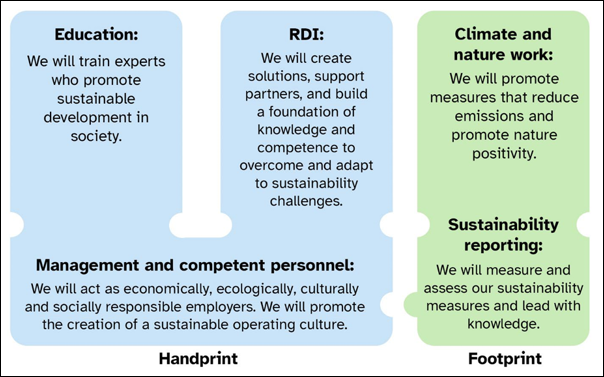
Sustainable development skills in degree programmes
At Jamk, building competence in sustainable development starts with a common course for all Bachelor’s degree students called Fundamentals of Sustainable Development (1 ECTS), which ensures a shared basic understanding. After this, sustainable development studies are integrated into each specific degree as part of the core professional skills. In the Master’s degree programmes, sustainable development competence is included in advanced professional studies. Competence in sustainable development in Jamk degree education is defined according to the joint recommendation of Finnish universities of applied sciences by Arene (2022):
Bachelor’s degrees
Graduating students are familiar with the principles of sustainable development, promote the implementation of those principles and act responsibly as professionals and members of society.
- They are able to use information related to their respective fields to find, adopt and establish sustainable solutions and operating models.
- Graduates also understand sustainability challenges, their interdependencies and the many perspectives of issues and problems.
Master’s degrees
Graduating students develop and manage sustainable and responsible operating methods in their work and support the sustainability transition in their work community and society.
- They are able to apply information and future visions about sustainable development as a basis for comprehensive sustainable solutions.
- They are able to analyse and assess the systemic dependencies of complex transdisciplinary problems and the different dimensions of solutions.
- In addition, they are able to manage the search for, adoption and establishment of sustainable solutions and operating models in their work community.
More information about Arene recommendations: Recommendation on the shared competences of universities of applied sciences and their application (Arene 2022)
More information about application: Kestävän ammattikorkeakoulutuksen käsikirja (Asikainen E. & Kangastie H., 2023) (available only in Finnish)
UN Sustainable Development Goals as a framework
The UN’s Sustainable Development Goals (SDGs) and sub-goals provide a foundation for developing responsibility skills and expertise across various degree programmes. Identify the UN Sustainable Development Goals and sub-goals that your course concretely promotes in terms of knowledge, skills, or other competencies and that a graduate can practically use in their own work to help advance society’s sustainability transition.
You find the SDGs in UN website.
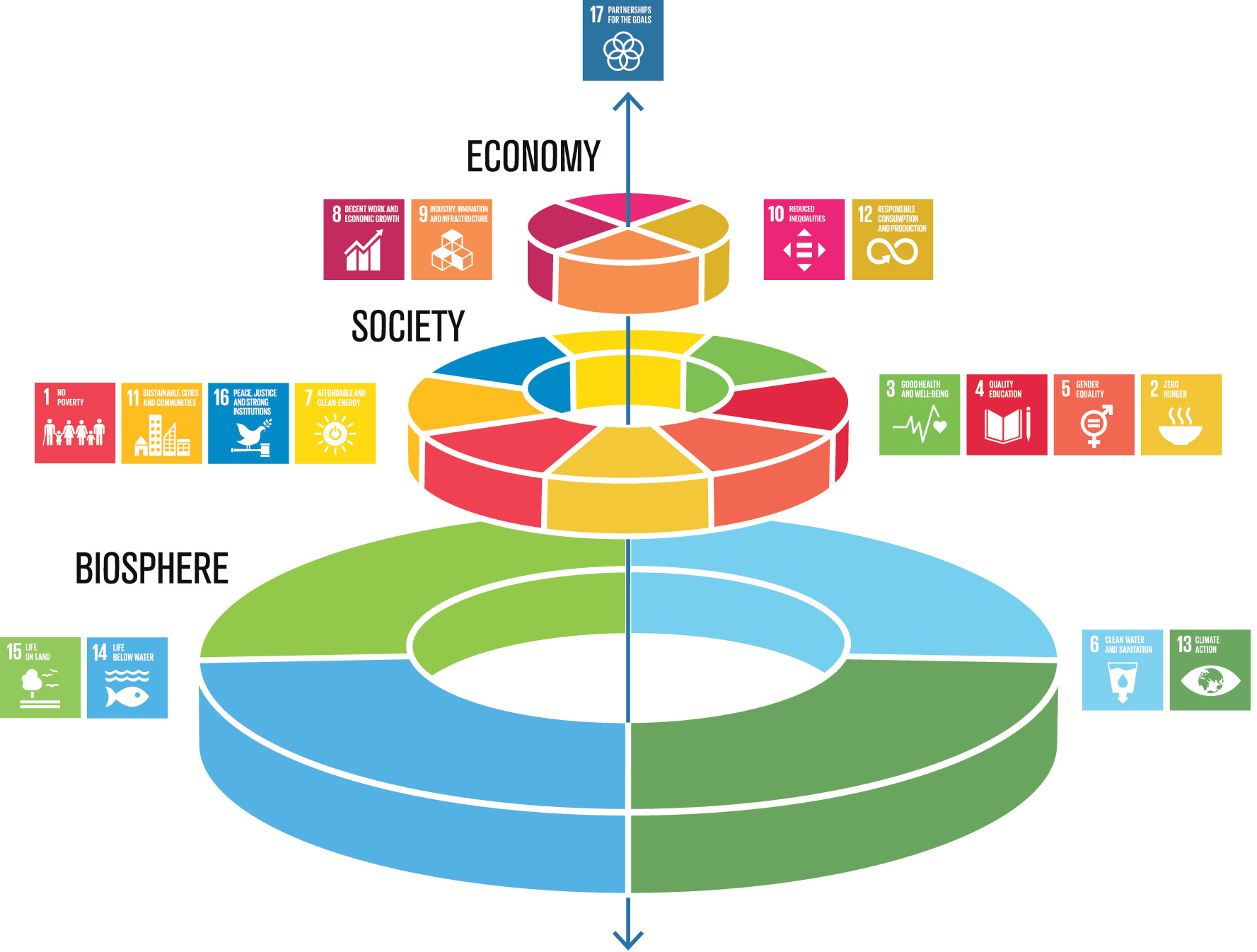
Figure 2. Hierarchical outline of the relations between the goals of the 2030 Agenda (Johan Rockström & Pavan Sukhdeev 2015)
Education maturity levels
Universities of applied sciences assess the impact of their activities on the sustainability level of education based on shared maturity level descriptions. You can explore how we can further improve the quality of education and practices by getting familiar with the current state of sustainability in education at the university of applied sciences as well as the actual maturity level descriptions:
Materials to support curriculum work
Kestävän ammattikorkeakoulutuksen käsikirja (Asikainen E. & Kangastie H., 2023) (FIN, PDF)
Description of sustainability maturity levels for UAS (Arene, 2026) (FIN, SE)
Sustainable and Responsible Jamk website
Megatrends 2026 (Sitra, 2026) (FIN, SE, ENG)
Creating Solutions Jamk University of Applied Sciences Strategy 2035 (Elmo intra, login required)
Jamk’s Quality Manual (2025) (Elmo-intra, login required)
Leena Liimatainen 30.5.2023, Updated 20.8.2026 Kirsi Knuuttila and Marianne Ekonen