Cross-institutional studying
Cross-institutional studying means that a student can complete courses at another Finnish higher education institution, usually free of charge. This enables access to a wider range of courses and allows for a more flexible study path.
Cross-institutional studying is based on teaching cooperation networks between higher education institutions, which are always based on a teaching co-operation contract. Jamk participates in several teaching collaboration networks, for example CampusOnline and EduJyväskylä.
Instructions for Jamk students regarding cross-institutional studies can be found in the Jamk student Help. Instructions for visiting students participating in cross-institutional studies organized by Jamk are available on the Visiting Student page.
Teaching cooperation networks
CampusOnline
CampusOnline is a teaching co-operation network of Finnish universities of applied sciences, offering free online studies from almost all 24 universities of applied sciences in Finland.
The following Jamk students who are registered as attending may complete CampusOnline studies:
- Degree students
- School of Professional Teacher Education students and
- Open University of Applied Sciences route students (Note: Students of “Route studies for secondary education students” cannot complete CampusOnline studies.)
EduJyväskylä
EduJyväskylä consists of Higher education institutions: JAMK University of Applied Sciences and the University of Jyväskylä, and Upper secondary institutions: Gradia Vocational College, Gradia Upper Secondary Schools Lyseo and Schildt, and Norssi Upper Secondary School.
The following Jamk students who are registered as attending may complete EduJyväskylä studies:
- Degree students
- International exchange students and
- School of Professional Teacher Education students
Other teaching co-operation networks
Jamk also participates in many other networks, which are typically field-specific or unit-specific. On the Study Search page, you will find information about educational cooperation networks in which Jamk participates and the course offerings available through them.
How do Jamk’s studies end up in cross-institutional studies?
Cross-institutional studying is part of the Ministry of Education and Culture’s funding model, and the offering at Jamk is decided within the units. The units provide the studies at their own expense, and they also receive the credits earned through cross-institutional studies.
In planning the offering, the key role is played by the educational planners and specialists of the units, who, in collaboration with managers, teachers, and other experts, decide which studies will be offered. The studies must be parts of existing degree programmes and follow the curriculum for degree students.
The cross-institutional study service (RIPA)
The Cross-Institutional Study Service (RIPA) automatically transfers study offerings, registrations, and study attainments between different higher education institutions. RIPA is not a separate study offering platform. Instead, it makes studies offered through different networks visible in the student’s own Peppi system.
For students, RIPA means that they can find cross-institutional studies in Peppi using the search function. Also the registration takes place in Peppi and the assessments and completed credits are automatically transferred to the student’s study record.
RIPA is used in teaching cooperation networks where students are granted a right to study at another higher education institution, and where enrolment and study attainment data are transferred between institutions.
Implementing RIPA in a new network
Roles Within the Unit
Before implementation, network-specific responsible roles must be assigned within the unit. The same person may perform more than one role.
- Network Lead: Often the person who initiates the process. They are familiar with the operation of the network, serve as the network’s primary contact person at Jamk, and ensure that information related to the network is communicated appropriately.
- Network Agreement Coordinator: Responsible for matters related to the network agreement, including drafting, storing, and maintaining the agreement.
- Peppi Coordinator: Creates the necessary Peppi connections for the courses and course implementations included in the network and defines the required enrolment periods and quotas.
Implementation Steps:
- CREATE OR SAVE THE NETWORK AGREEMENT IN CLOUDIA
Responsible: Network Agreement Coordinator
A network agreement is always required for teaching cooperation. The agreement is drawn up and signed in Jamk’s contract management (Cloudia Agreement). Before drawing up an agreement, read Cloudia’s instructions.
Confirm in advance the details of the partner university and signatories.“Home higher education institution” refers to the university or higher education institution where the student has the right to complete a degree. “Target higher education institution” refers to the university or higher education institution that provides the instruction, where the student has the right to complete studies that are part of their degree based on an agreement.
The agreement template is available in Cloudia. Each agreement is assigned a unique agreement identification number. A new agreement is created and signed in Jamk’s contract management system Cloudia, and an agreement created elsewhere is saved also in Cloudia.
AGREEMENT DETAILS:
Agreement type: Cooperation agreements → Higher Education Institutions.
Agreement template: Teaching Cooperation Network Agreement (RIPA). This agreement template is used when Jamk is the coordinating higher education institution in the network.
The network abbreviation is not visible to students, but is visible to administrative users in Peppi. Do not use unusual characters or the letters: ä, ö and å. Use a hyphen – instead of a space. The abbreviation shall be added to the name of the cooperation agreement. Note: The administrator of RIPA may make minor modifications to the requested abbreviation when creating the network if the abbreviation is already in use.
NAME OF THE AGREEMENT:
Format: “Agreement on the [Teaching Collaboration Network’s name], [network’s abbreviation] (Jamk/[unit abbreviation]”
Unit abbreviations: AOKK, Hyvi, LIKE, Technology, KOPA
Example: Agreement on the Rehabilitation Collaboration Network, Oskuri (Jamk/Hyvi)
The responsible person: Network Lead (in unit)
AGREEMENT APPENDICES:
Network Offerings. Names and contact details of the contact persons. If the network has agreed on specific studies/quotas, these will be stated in the appendix. The contracting parties shall negotiate and confirm the courses of the network for the upcoming academic year no later than the end of May of the previous academic year. The appendix can be updated without re-signing the agreement. Below is an example of an appendix.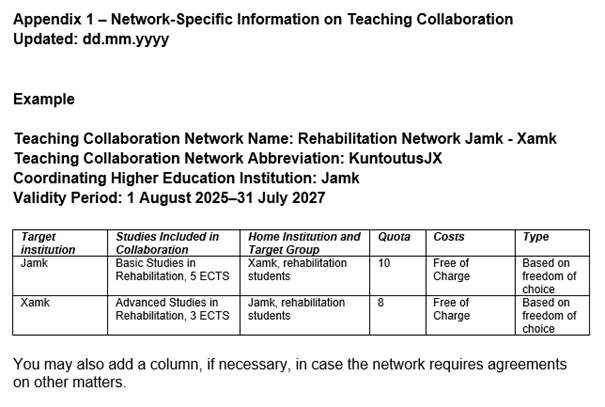
If the teaching cooperation network agreement has been concluded in another higher education institution, Jamk’s copy of the agreement is always also exported to Jamk’s contract management (Cloudia Agreement).
If Jamk is not the coordinating higher education institution of the network, the Network Lead at Jamk is responsible for updating the changed agreement information in Cloudia (e.g. under Other attachments in the original agreement). Read the contract management instructions (Cloudia Agreement):
Drafting a new contract (Cloudia Agreement)
Importing a contract (Cloudia Agreement) - SUBMIT THE NETWORK INFORMATION USING THE E-FORM
Responsible: Network Lead
When a network is to be connected to RIPA, the Network Coordinator submits the required information using an e-form. Any amendments to the network agreement must also be reported using the same form.
If Jamk is the coordinating higher education institution, Jamk network contact person (in Kouke) submits the information from e-form to CSC, which adds the network to RIPA. If another higher education institution acts as the coordinating institution, the network contact person of that institution is responsible for submitting the information to CSC. Note: The e-form must always be completed, even if Jamk is not the coordinating higher education institution.
- COMMUNICATE THE ADDITION OF THE NETWORK TO RIPA
Responsible: Network Lead
The person who submitted the e-form will receive a confirmation by email once the network has been added to RIPA. The confirmation is sent either by Jamk network contact person or by the contact person of another higher education institution participating in the network, depending on which institution is the coordinating institution of the network. Once the network has been connected to RIPA and Jamk is the coordinating institution, the Network Lead is also responsible for informing the contact persons of the other participating institutions. - NETWORK TARGETING IN PEPPI
Responsible: Network Lead + Peppi Administrator
The Network Lead submits a Peppi support ticket through the Helpdesk. The ticket specifies:
Which student group(s) should be able to see the course offering: Degree programme or student group? Degree type (Bachelor’s/Master’s UAS),? Any restriction based on the starting year of studies?
Whether a separate template is required, in which case students will receive their own group code (Yes/No?)
Whether the basic funding code will be used (Yes/No?)
Peppi Administrator creates the targeting settings and closes the ticket once the work has been completed.
The targeting settings determine which students at Jamk can see the network’s course offering in Peppi. If the targeting settings have not been defined, Jamk students will not be able to see the studies or enrol in them. - CREATE COURSE AND IMPLEMENTATION CONNECTIONS IN PEPPI
Responsible: Peppi Coordinator
The Peppi Coordinator creates the necessary connections between the network and the courses and course implementations that belong to it. At the same time, student quotas and enrolment periods are defined. See detailed instruction below: “Peppi-related instructions”.
Based on these connections, the network’s course offering becomes visible to students at the other higher education institutions participating in the network. If the connections have not been done, Jamk’s courses are not visible to the students at other institutions. - INFORM TEACHERS AND STUDENTS
Responsible: Network Lead
The Network Lead communicates information about the network and its course offering to those students, teachers, and study counsellors for whom the information is relevant.
Instructions and Further Information:
Cross-Institutional Studies (RIPA) Teams channel in Peppi-Teams
Peppi/RIPA support: Peppigents
Peppi-related instructions
A planner’s instructions
Adding study elements to the cross-institutional study network
Manually adding a network and its duration to a study element
Inheritance of cross-institutional study networks
Adding and removing a course from the network
Adding and removing a separate study module from the network
Adding and removing a study module from the network
Network information and quota groups for implementation
Creating a new implementation, adding and removing an implementation from the network
Searching based on a cross-institutional study network
A teacher’s instructions
Network information on implementation